Escape The Matrix Make Money Fast — Progression Ladder
A practical climb from $20 and MatrixOS gigs to shops, Holdings, and markets without feeding every scam on the desktop.
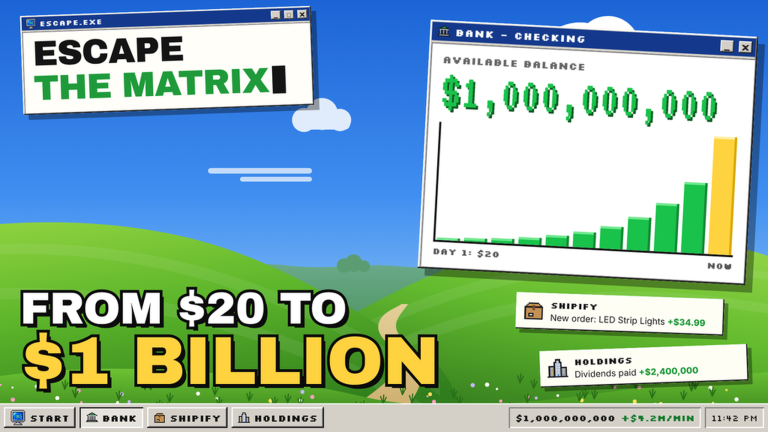
Escape The Matrix sells a clear fantasy: start with pocket change on an old PC and climb toward one billion dollars. “Make money fast” in this game does not mean clicking the loudest crypto banner. It means climbing a ladder where each rung multiplies the last — gigs fund shops, shops fund Holdings and store upgrades, and only then do markets and heavier businesses make sense. This guide is that ladder, plus the red flags that wipe early bankrolls.
New to the desktop? Start with Getting Started, then use this page as your cash roadmap.
The ladder at a glance
- Stabilize with HustleHub — tagging, proofreading, scam detection; respect the ~15s cooldown.
- Open small shops / early business pads — spend surplus, never your entire buffer.
- Invest in Holdings and store upgrades — the November 2026 update direction for scaling owned income.
- Touch markets and advanced hustles selectively — dropshipping, stocks, crypto, game dev, reselling, influencer — knowing most pitches are scams.
- Aim endings and long-term wealth routes — billion-dollar pressure with Mom watching.
Skip a rung and the simulation will happily take your money. Climb in order and the same systems start working for you.
Rung 1 — Gig cash that does not evaporate
Your first job is not to look rich. It is to make the starting ~$20 irrelevant. Run HustleHub until you can describe, from memory, what a full tagging clear feels like versus a partial proofreading pay. Aim for clean 6/6 tagging when you are sharp (observed full pays around ~$7), and treat scam-detection jobs as training for later.
Rules for rung 1:
- Bank a cushion before any business unlock that costs most of your cash.
- Stop a session while you are still accurate; tired play creates expensive mistakes.
- Read the deep job breakdown on HustleHub gigs if payouts feel random.
Fast money here is really reliable money. Reliability is what lets you buy rung 2 without panic.
Rung 2 — Small shops and first companies
Once gigs refill your wallet on command, unlock the smallest shops or company-style pads that fit your surplus. The official fantasy path is “start with $5 gigs, end up owning companies.” Early ownership should feel like a second income stream, not a second job that starves your gig fund.
Healthy unlock habits:
- Pay the pad only if you can still run several HustleHub cycles afterward.
- Prefer upgrades that shorten work or raise throughput over pure cosmetics.
- If an unlock demands “trust me” money with no clear loop, walk away — that is rung-skip bait.
You are still early. The goal is a modest, understandable loop you can explain in one sentence.
Rung 3 — Holdings and store upgrades (scale layer)
The newer update focus — Holdings and store upgrades — is where Escape The Matrix expects serious players to spend attention. These systems exist to turn ownership into something closer to passive or semi-passive growth compared with pure manual gigs. Prioritize upgrades that:
- Increase revenue per real-time minute.
- Reduce failure points (stockouts, weak ratings, slow processing — whatever your store UI emphasizes).
- Stack with money you already understand from rung 2.
Do not max every upgrade blindly. Buy the ones that pay back before you feel bored, then return to gigs or light markets to fund the next tier. For a dedicated Holdings spend guide, open Holdings & store upgrades. For a systems tour of dropshipping, stocks, crypto, game dev, reselling, and influencer lanes, open businesses and markets.
Rung 4 — Markets without becoming the mark
Markets are where “make money fast” fantasies and “lose money faster” realities collide. Stocks and crypto can spike; they can also delete a night of gig work. Dropshipping and reselling can scale; they can also bury you in bad inventory decisions. Influencer life can print status; the game itself calls out fake influencer paths and warns that most of it is a scam.
Use markets when:
- Holdings/store income already covers mistakes.
- You are testing small position sizes, not your entire net worth.
- You can afford to be wrong and still climb.
Avoid markets when:
- You are still learning MatrixOS controls.
- A single loss would force you back to zero-cushion gig panic.
- The pitch promises billionaire speed with no work loop.
Cross-check priorities with the tier list as community rankings mature — use it as a hint sheet, not a substitute for reading risk on screen.
Red flags for scam hustles
Memorize these. They show up in scam-detection gigs and in real unlock pitches:
- All-in language — “invest everything now.”
- Guaranteed multipliers with no skill check.
- Urgency that blocks you from reading the UI.
- Social pressure tied to Mom, status, or influencer clout without a cash formula.
- Complexity cosplay — charts and jargon that hide a simple “give us your money” button.
If a hustle fails the “can I explain how this earns after the fee?” test, it is entertainment at best and a trap at worst. Legitimate rungs always leave you a path to verify income after the purchase.
Session templates for faster climbs
Short session (15–25 minutes)
- Two to four focused HustleHub jobs (accuracy over volume).
- Buy one store/Holdings upgrade only if surplus remains.
- Log off while richer than you started.
Medium session (45–90 minutes)
- Build a gig cushion.
- Push one business loop (shop throughput or a careful market test).
- Reinvest profits into the next upgrade tier.
- Optional: skim ending notes if a story beat appeared — see all endings.
Recovery session (after a scam loss)
- Ban markets for the session.
- Return to tagging/proofreading only.
- Rebuild to your previous cushion before unlocking anything new.
What “fast” actually means toward $1B
A billion is a late-game number. Fast progress means minimizing dead time and wiped bankrolls, not hitting a meme net worth in one evening. Players who look fast on the leaderboard usually:
- Never donated their cushion to an obvious scam.
- Treated gigs as a renewable floor.
- Bought Holdings/store power on purpose.
- Sized market bets small.
- Kept Mom’s watching presence in mind when story and money choices overlapped.
Next reads
- Optimize job pay and cooldowns: HustleHub gigs.
- Rank what to fund first: tier list.
- Understand each business lane: businesses and markets.
Climb the ladder in order. The simulation rewards patience dressed as hustle — and it punishes anyone who confuses a scam popup with a shortcut.
Frequently Asked Questions
Quick answers about gigs, codes, MatrixOS, and endings.
What is the fastest safe way to make money early?
Run accurate HustleHub gigs (especially clean tagging), bank a cushion, then buy small shop or store upgrades without emptying your wallet.
Should I buy stocks or crypto right after joining?
No. Stabilize with gigs and early ownership first. Markets are high variance and can erase your starter progress in one bad click.
What are Holdings and store upgrades for?
They are the scaling layer added around the November 2026 update direction — invest in them once shops exist so income grows beyond pure manual gigs.
How do I know a hustle is a scam?
Watch for all-in pressure, guaranteed multipliers, fake urgency, and pitches with no clear work loop. If you cannot explain how it pays after the fee, skip it.
When do gigs stop being worth my time?
When Holdings, store upgrades, or a proven business loop consistently beat careful gig income. Keep HustleHub as a safe refill tool.
Does this guide help with the billion-dollar goal?
Yes — by preventing wipeouts and sequencing upgrades. The $1B target is a long arc; this ladder keeps each session compounding instead of resetting.